
Treating gum disease without a scalpel.
LANAP uses a specific laser to clear infection from deep gum pockets. No cutting, no stitches, and most patients are back to normal life the following day.
What LANAP is
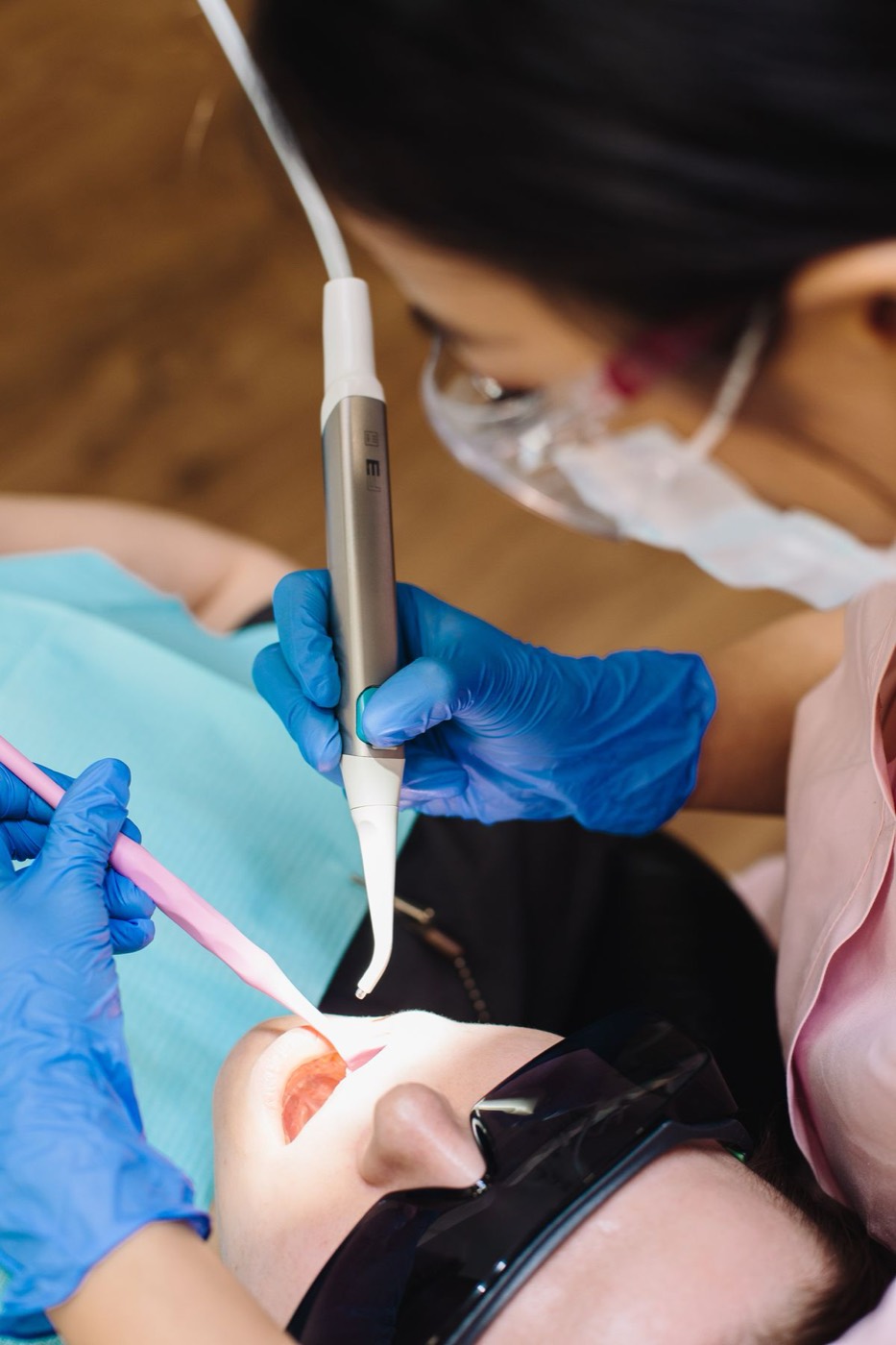
LANAP stands for Laser-Assisted New Attachment Procedure. It's an FDA-cleared protocol that uses a particular wavelength of laser light to treat moderate and advanced gum disease.
The useful property of that wavelength is selectivity: it targets diseased, inflamed tissue and bacteria, and passes over healthy tissue. So instead of cutting the gum open, folding it back, cleaning underneath and stitching it closed, we pass a fibre roughly the width of three human hairs into the pocket alongside the tooth and do the work from inside.
We then clean the root surfaces thoroughly, and make a second pass with the laser to form a stable clot that seals the pocket — which is what lets the gum reattach to the tooth rather than simply healing over.
What it replaces
The conventional alternative is osseous surgery: gum flap surgery, done under local anesthetic, with sutures and a recovery measured in weeks rather than days. That operation still has its place, and for some cases it remains the better choice. But for a great many patients, LANAP reaches the same goal with substantially less to endure.
The most common thing we hear afterward is that people expected it to be much worse than it was.
Why we treat this way
Dr. Alkanan on laser gum treatment and the case for doing the least invasive thing that will actually work.
3 min 20 sec · More in our patient education videos.
Does it hurt?
The area is numbed with local anesthetic, so the procedure itself is comfortable.
Afterward is where LANAP really differs. There's no incision and no sutures, so instead of the significant post-operative soreness that follows flap surgery, most patients report tenderness and a slightly odd feeling in the gums for a day or two, usually manageable with over-the-counter pain relief.
Your teeth may feel sensitive or slightly loose for a few weeks. Both settle. The looseness is expected — it's the tissue reorganising as it reattaches — and the teeth firm up as healing progresses.
How long does it take?
We normally treat the mouth in two appointments of roughly two hours each, half the mouth at a time. A follow-up visit a few weeks later checks how the pockets have responded, and we then move you onto a maintenance schedule.
Because there's no surgical opening, you can eat that same day — softly — and return to work the next.
What recovery is really like
- Days 1–2: Tenderness. Soft food only. It's important not to disturb the clot in the pockets, so no brushing directly on the treated gums yet.
- Days 3–7: Most patients are comfortable. Gradually reintroducing normal food.
- Weeks 2–4: Back to your usual routine, brushing and flossing normally. Some sensitivity to cold lingers.
- Months 3–12: The slow part — bone and attachment can continue to improve for up to a year afterward. We measure the pockets again to confirm.
Who is a good candidate
LANAP is designed for people with moderate to advanced periodontitis — pockets deeper than about 5mm, bleeding gums, bone loss visible on x-rays, and in some cases teeth that have started to loosen or drift.
It's particularly worth asking about if you:
- Have been told you need gum surgery and don't want to be cut
- Take blood thinners, which complicate conventional flap surgery
- Have diabetes or another condition that slows healing
- Have had scaling and root planing but the pockets haven't closed
It is not the right tool for early gum disease, which usually responds to non-surgical therapy — and we'd rather start you there than sell you a laser you don't need. It also can't save a tooth that has already lost too much of its supporting bone.
The honest limit: LANAP treats the infection, but it does not change what caused it. Without regular maintenance afterward, gum disease returns. Everyone who has this done goes onto a cleaning schedule, usually every three to four months.
What it costs, and how people pay for it.
We can't put a real number on a webpage, because the honest answer depends on what your exam and 3D scan show. What we can promise is that you'll get a written treatment plan with an exact figure on it before you commit to anything. No surprises added later.
Most patients have some insurance coverage, and we'll check yours and tell you what it will and won't pay. For the balance, we work with three financing companies so you can spread the cost over time — many patients qualify for plans with no interest if paid within the promotional period.


Ask us at your consultation and we'll walk you through the options and the monthly numbers.
Coming from Yakima? See LANAP at our Yakima office.
Related treatments
Ready to talk it through?
Call any of our three offices, or send us a request and we'll get back to you. Phone hours are Monday to Friday, 7am to 3pm.