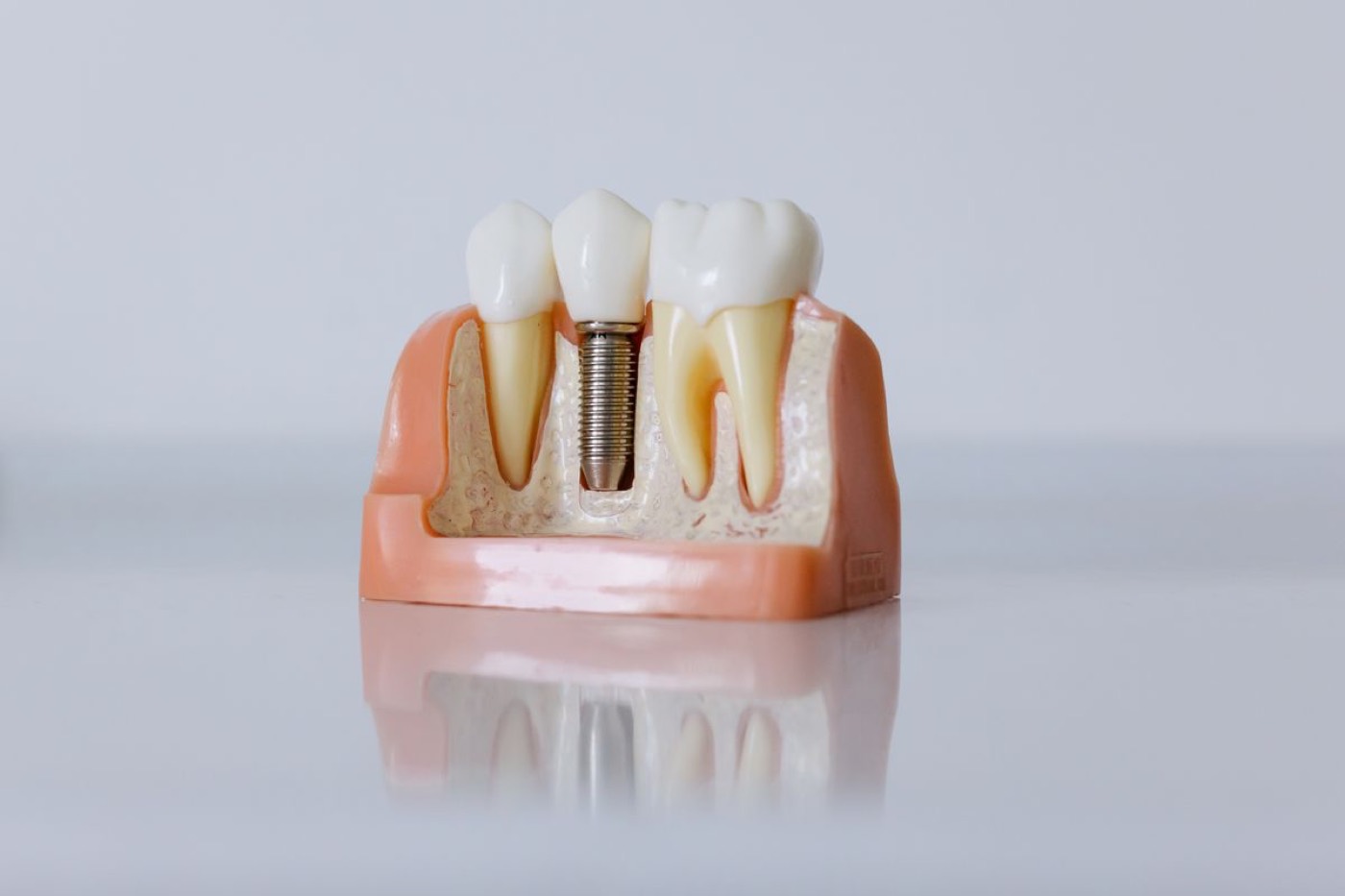
What a dental implant actually is
Most people picture a fake tooth. An implant is really three separate parts.
The implant itself is a small titanium post, about the size of the
root it's replacing, that we place into the jawbone. Over the following months your
bone grows onto its surface and locks it in place. That process has a name —
osseointegration — and it's the reason an implant feels solid rather than fitted.
On top of that sits a small connector called an abutment, and on top
of that goes the crown — the part you see and chew with, shaped and
shaded to match your other teeth.
You lose a tooth, and the bone that used to hold it starts to melt away.
An implant is the only replacement that stops that happening, because it puts pressure
back into the bone the way a real root did.
Does it hurt?
Placing an implant is usually easier on patients than the extraction that came before
it. That surprises people, but it's what we hear back most often.
The area is fully numbed, so you feel pressure and movement but not pain. Afterward,
expect soreness rather than sharp pain — most patients manage it with ibuprofen and
are comfortable within two or three days. Swelling, if you get it, peaks around 48
hours and then settles.
If dental anxiety is the thing standing between you and treatment, say so when you
call. We offer IV sedation in-house, and for many people
that turns the whole appointment into something they simply don't remember. For longer
cases we can also arrange full general anesthesia with a certified registered nurse
anesthetist here in our office.
How long does it take?
The surgery is the short part. Placing a single implant usually takes between 45
minutes and an hour and a half, and you go home the same day.
The waiting is the long part. Bone needs roughly three to four months
to fuse to the implant before it can carry a crown. So from start to finished tooth,
plan on four to six months for a straightforward case.
Two things change that timeline:
- If you need a graft first, add three to six months. See
bone grafting.
- Sometimes we can place the implant the same day we remove the tooth,
which saves months. Whether that's safe depends on how much healthy bone is there and
whether there's any infection. Your 3D scan tells us.
What recovery is really like
Most people take the rest of the day off and go back to work the next morning. Desk
work, certainly. Hold off on the gym and anything strenuous for about a week — raising
your blood pressure raises the odds of bleeding and swelling.
- Days 1–3: Soft foods. Soup, eggs, yogurt, pasta. Chew on the other
side. Ice on and off the first day.
- Days 3–7: Soreness is fading. Most patients are off pain relief.
You'll rinse with a prescribed mouthwash rather than brushing directly over the site.
- Week 2 onward: Back to normal eating, gently. We see you for a
quick check.
- Months 2–4: Nothing to do but let it heal. You won't feel this part.
Don't smoke during healing if you can possibly help it. Smoking is the single biggest
controllable reason implants fail, and we'd rather tell you that up front than after.
Who is a good candidate
Most adults missing one or more teeth are candidates. What we're actually checking at
your consultation is:
- Is there enough bone? If not, we can usually build it. That's a
routine part of what we do, not a reason to be turned away.
- Are the gums healthy? Active gum disease has to be treated first,
or it will attack the implant the same way it attacked your teeth. See
periodontal therapy.
- Is your general health stable? Diabetes is fine when it's
controlled. Some medications — particularly certain bone drugs — need discussing
before we plan anything.
- Have you finished growing? For teenagers we wait until the jaw
has stopped developing, or the implant ends up in the wrong place a few years later.
If we don't think an implant is your best option, we'll say so and tell you what is.
That happens, and it's a better outcome than a treatment that doesn't hold up.
How we plan it
Every implant here starts with a CBCT scan — a
3D image of your jaw. On that scan we can see the exact width and height of bone
available and where the nerves and sinuses sit, and we place the implant virtually
before we place it in you.
It is a slower way to work. It is also the reason we can tell you in advance what
we're going to do, rather than finding out halfway through.