What All-on-X is
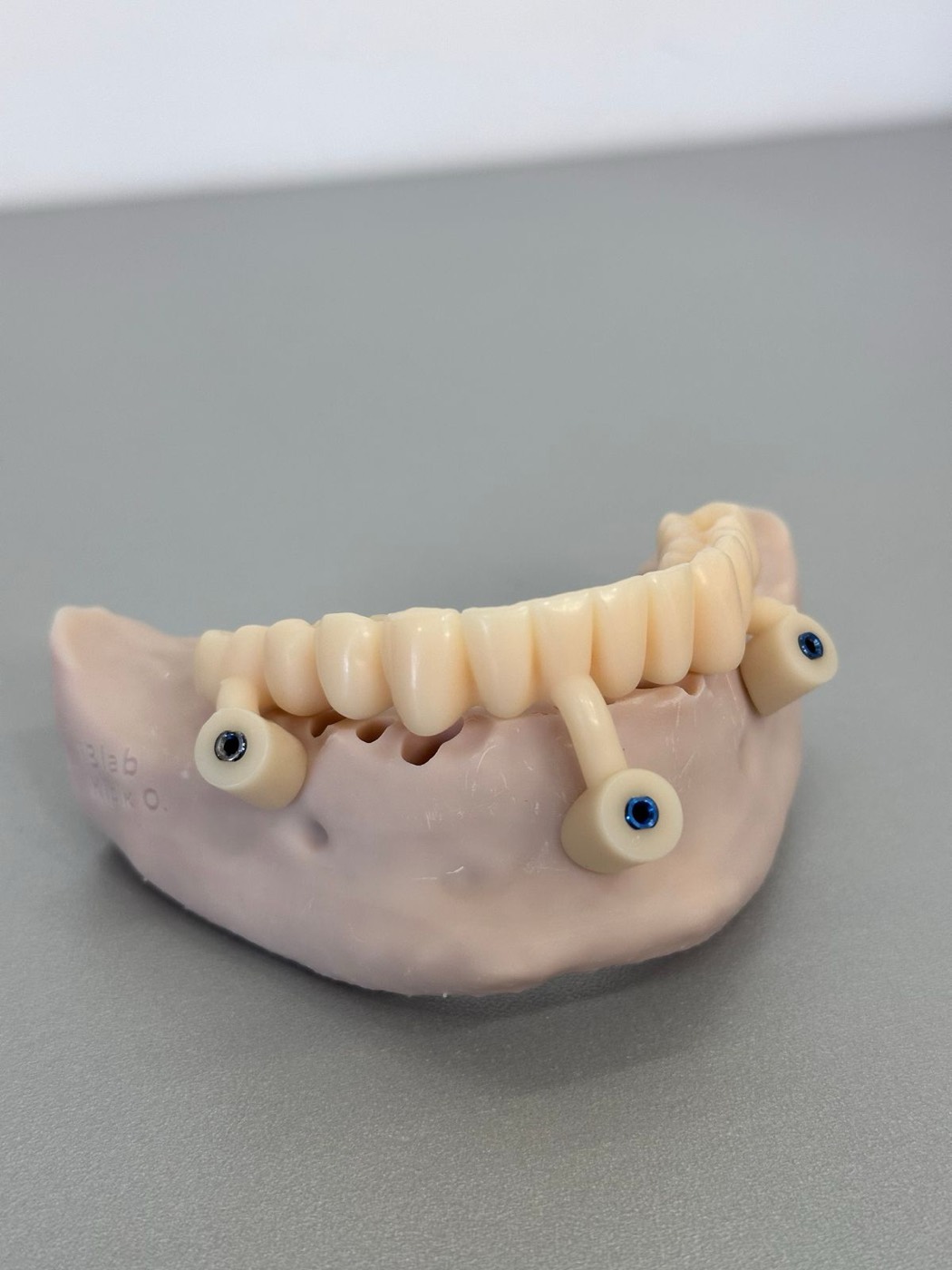
Instead of replacing twelve or fourteen teeth with twelve or fourteen implants, we
place four to six implants at carefully chosen angles and anchor one solid bridge of
teeth across them.
The "X" is simply the number of implants. Some jaws are well served by four. Some
need six for the load they'll carry. We decide that from your 3D scan and your bite,
not from a marketing name.
The result is fixed. Only we can remove it, at your check-ups, to clean underneath.
You brush it, floss under it with the tools we give you, and otherwise live with it
as teeth.
How it differs from a denture
A conventional denture rests on your gums and relies on suction. It moves. It limits
what you can bite into, it covers your palate so food tastes duller, and because
nothing is stimulating the bone underneath, the jaw keeps shrinking year after year —
which is why dentures need relining and eventually stop fitting at all.
All-on-X is anchored into bone. It doesn't move, it doesn't cover your palate, and
the implants keep the bone loaded so it holds its shape.
On traditional dentures: we do still make and repair them, and for
some patients they are genuinely the right answer — usually on grounds of health or
cost. If that's you, we'll say so honestly rather than steer you toward surgery.
If you're already in a denture
For patients wearing something that moves, or who have been told the rest of the arch
is going.
2 min 41 sec · More in our
patient education videos.
Does it hurt?
This is bigger surgery than a single implant, and we won't pretend otherwise. It is
also almost always done under IV sedation, so the
appointment itself is something most patients have no memory of.
For a case this long we can also arrange full general anesthesia, where a certified
registered nurse anesthetist comes to our office and puts you completely asleep — see
sedation and anesthesia.
Afterward, expect real soreness and noticeable swelling for the first three to five
days. We manage it with prescribed medication, and we call you the next day to check.
Most patients tell us the discomfort was less than the years of trouble that led them
here — but the first week asks something of you.
How long does it take?
Surgery day is long: usually four to six hours per arch, including removing any
remaining teeth, placing the implants, and fitting your temporary teeth.
You leave with teeth. That same day. They are a temporary set — a
little less refined than the final ones, and you'll eat softly on them — but you do not
go home without teeth.
- Day one: Teeth out, implants in, temporary arch fitted.
- Months 1–4: Bone fuses to the implants. You wear the temporaries
and eat progressively more normally.
- Around month 4–6: We take final impressions and fit the permanent
arch, made by one of the labs we work with in the United States.
What recovery is really like
- Days 1–3: The hardest stretch. Swelling peaks around 48 hours.
Liquids and very soft food. Ice, rest, medication on schedule rather than waiting
for pain.
- Days 4–10: Swelling drops off quickly. Most patients feel
noticeably better each day. Still soft food.
- Weeks 2–6: Back to work and normal life. Gradually more texture in
your diet, but nothing hard or crusty on the temporaries.
- After the final arch is fitted: Eat normally. Steak, apples, corn
on the cob — the things people tell us they've missed.
Plan on a week where you don't have much on. Patients who schedule this over a quiet
week do far better than patients who try to work through it.
Who is a good candidate
All-on-X tends to be right for people who are:
- Missing most of the teeth in an arch, or facing losing them to advanced gum
disease or decay
- Already in a denture and tired of it moving, or unable to tolerate one
- Wanting something fixed rather than something removable
What we check: whether there is enough bone in the right places (angled implants often
let us avoid grafting entirely, even in jaws that have shrunk considerably), whether
any gum infection needs clearing first, and whether your general health supports a
longer procedure under sedation.
Heavy smoking materially raises the failure rate here. We'll talk about it honestly
rather than skip past it.
How we plan it
A CBCT scan and a digital scan of your bite let us plan every implant position before
surgery day, and let the lab begin your temporary teeth in advance. That planning is
what makes it possible to hand you a fixed set of teeth the same afternoon we remove
the old ones.