
Building back the bone an implant needs.
Being told you "don't have enough bone for implants" is not the end of the conversation. Rebuilding bone is routine specialist work, and it's a large part of what a periodontist is trained to do.
Why bone disappears in the first place
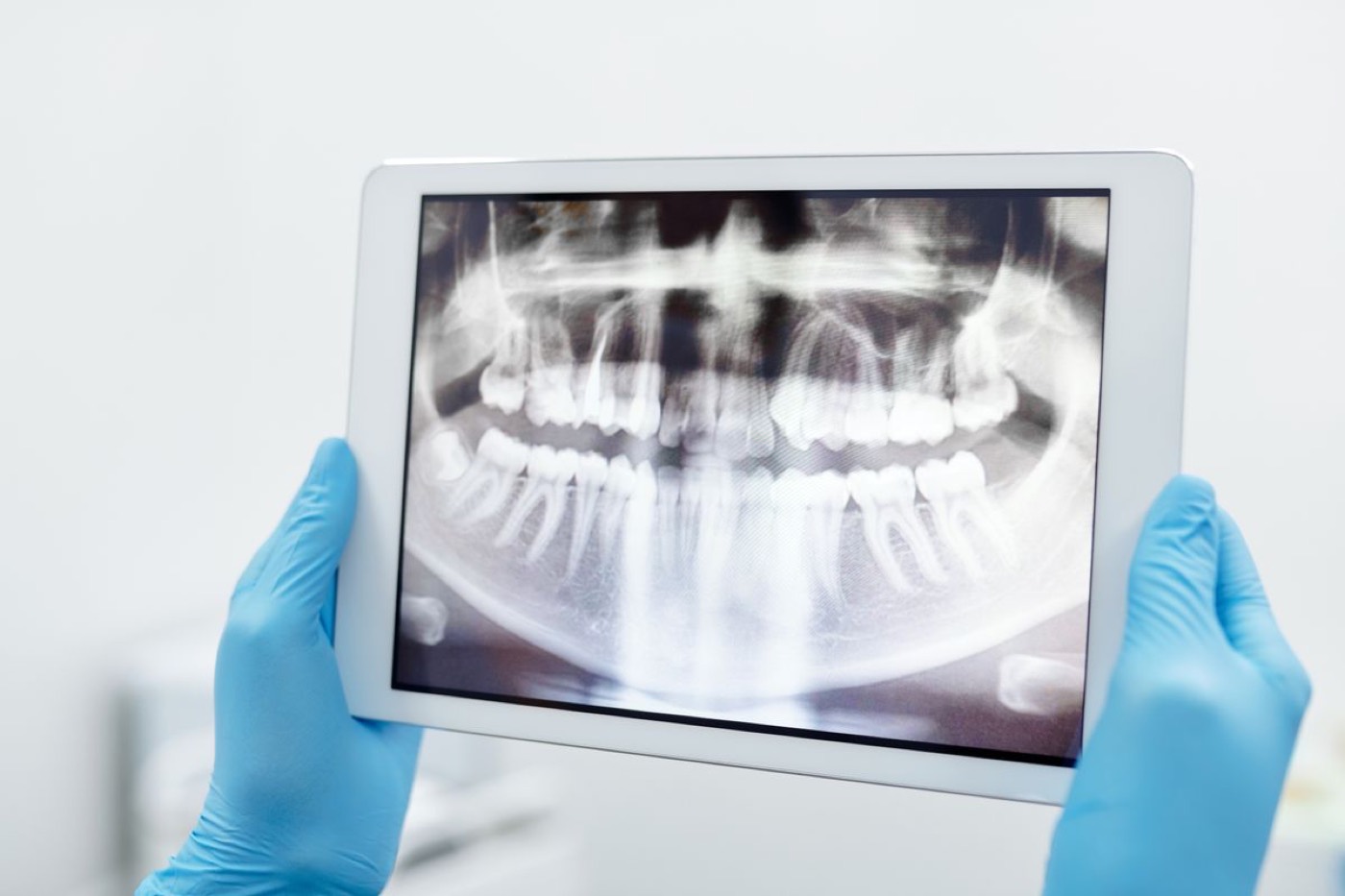
Jawbone exists to hold teeth. Take the tooth away and the body, sensibly enough, stops maintaining the bone around it. Most of the shrinkage happens in the first year after an extraction, and it never fully comes back on its own.
Advanced gum disease does the same thing while the tooth is still there — it eats away the bone from around the root. Long-term denture wearing accelerates it too, because a denture presses on the gums without ever loading the bone.
A graft doesn't just add material. It gives your own body a scaffold to grow real bone into. Months later, what's there is yours.
The different kinds, in plain terms
Socket preservation
Done at the same appointment as an extraction. We place graft material into the empty socket straight away, which largely prevents the collapse that would otherwise happen over the following months. If you know you want an implant later, this is the cheapest and easiest bone you will ever gain.
Ridge augmentation
For a site that has already shrunk — usually because the tooth came out years ago. We rebuild the width or height of the ridge so an implant can be placed in the correct position rather than wherever the leftover bone happens to be.
Sinus lift (sinus augmentation)
Only relevant in the upper back jaw. Your sinus sits directly above those teeth, and when the molars are lost the sinus tends to expand downward into the space. A sinus lift gently raises that membrane and places graft material beneath it, creating the height an implant needs. It sounds alarming and is, in practice, one of the more predictable procedures we do.
L-PRF — using your own blood
We draw a small sample of your blood at the start of the appointment, spin it in a centrifuge, and separate out a concentrated layer of platelets and growth factors. That material goes into the graft site alongside the graft.
Because it comes from you, there's no rejection risk and no extra cost for materials. Patients generally report less swelling and more comfortable healing when we use it.
Does it hurt?
Less than most people brace themselves for. Socket preservation adds essentially nothing to the discomfort of the extraction it accompanies — you'd struggle to tell the difference.
Larger grafts and sinus lifts are more involved, and you should expect soreness and some swelling for several days. You'll be numb throughout, and IV sedation is available for any of it.
After a sinus lift specifically, we'll ask you not to blow your nose, not to fly, and to sneeze with your mouth open for a couple of weeks. Odd instructions, but they matter — pressure changes can disturb the graft while it's setting.
How long does it take?
- Socket preservation: adds about 15 minutes to an extraction.
- Ridge augmentation: roughly 60–90 minutes.
- Sinus lift: roughly 60–90 minutes.
Then comes the wait, which is the real cost of grafting. Bone grows slowly. Expect three to six months before the site is ready for an implant, and up to nine for a large sinus graft. Sometimes we can place the implant and the graft in the same appointment; your scan decides that.
What recovery is really like
- Days 1–3: Soreness and swelling, peaking around 48 hours. Ice, soft food, medication as prescribed.
- Days 3–10: Steadily better. Most people are back at work the next day and off pain relief within a few days.
- Weeks 2–3: Any stitches come out or dissolve. We check the site.
- Months 3–6: Nothing to feel or do. The bone is quietly forming.
Don't smoke. Grafts fail in smokers far more often than in anyone else, and a failed graft means starting again.
Who is a good candidate
Almost anyone who wants implants but has been told there isn't enough bone. We assess it on a CBCT scan, which measures precisely how much bone you have and where — general dental x-rays can't show this properly, which is why some patients arrive having been told implants are impossible when they aren't.
Things that need discussing first: uncontrolled diabetes, smoking, active gum infection, and certain bone-density medications. None of these are automatic disqualifications, but all of them change the plan.
What it costs, and how people pay for it.
We can't put a real number on a webpage, because the honest answer depends on what your exam and 3D scan show. What we can promise is that you'll get a written treatment plan with an exact figure on it before you commit to anything. No surprises added later.
Most patients have some insurance coverage, and we'll check yours and tell you what it will and won't pay. For the balance, we work with three financing companies so you can spread the cost over time — many patients qualify for plans with no interest if paid within the promotional period.



Ask us at your consultation and we'll walk you through the options and the monthly numbers.
Related treatments
Ready to talk it through?
Call any of our three offices, or send us a request and we'll get back to you. Phone hours are Monday to Friday, 7am to 3pm.