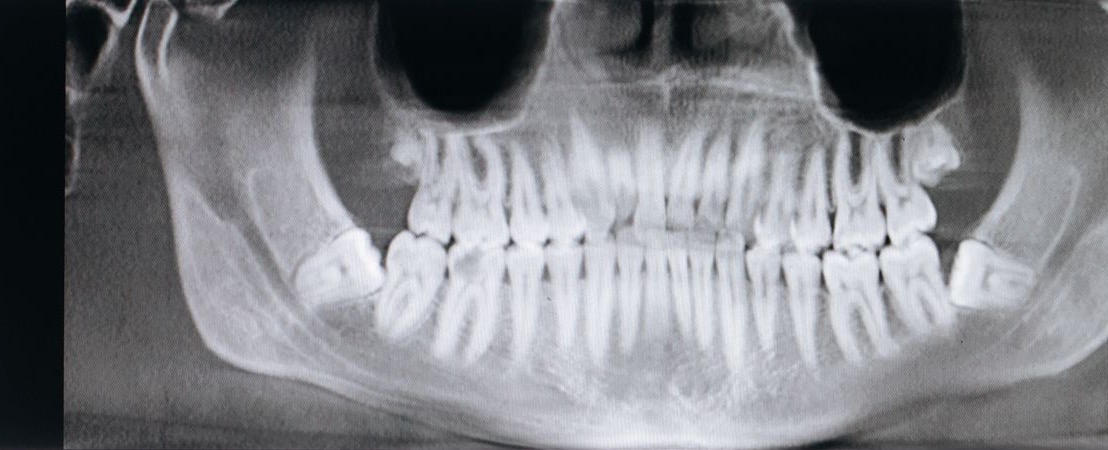
What wisdom teeth are, and why they cause trouble
Wisdom teeth are your third molars — the last four teeth to arrive, usually somewhere
between seventeen and twenty-five. For most people the jaw simply doesn't have room
left by the time they turn up.
When there isn't room, the tooth becomes impacted: stuck at an angle,
partly buried under gum or bone, or pressing into the tooth in front. That causes
problems in fairly predictable ways.
- Infection. A partly erupted wisdom tooth has a flap of gum over it
that traps food and bacteria. The resulting infection — pericoronitis — is painful,
recurring, and can spread.
- Decay. They sit at the very back where a toothbrush barely reaches.
They decay, and so does the healthy molar pressed against them.
- Damage to the tooth in front. An angled wisdom tooth pushes into
the second molar and can destroy the root or the bone beside it.
- Gum disease. The pocket behind a partly erupted wisdom tooth is
impossible to clean and becomes a reservoir of infection for the whole area.
- Cysts. Uncommon, but a buried tooth can develop a fluid-filled sac
that damages bone quietly over years.
Not every wisdom tooth needs removing. If yours have come through
straight, you can clean them, and they aren't causing problems, the honest answer is
usually to leave them alone and keep an eye on them. We'd rather tell you that than
take out four teeth that were doing no harm.
Does it hurt?
Not during. The area is fully numbed, and most patients here choose to be sedated on
top of that — in which case there is nothing to experience at all.
Afterward is real but manageable. Expect soreness and swelling that peak around
48 to 72 hours and then fall away quickly. Most people are
comfortable on ibuprofen and paracetamol; we prescribe something stronger for the first
couple of nights where the case warrants it.
A lower impacted tooth that has to be sectioned and lifted out of bone is a bigger
event than an upper one that lifts straight out. If we're doing all four, that's one
recovery rather than four — which is usually the argument for doing them together.
Sleeping through it
Two options, and this is the part patients care about most:
- IV sedation, provided in-house by Dr. Alkanan. You stay technically
conscious but deeply relaxed, and the amnesic effect means nearly everyone remembers
nothing of it.
- General anesthesia, where a certified registered nurse anesthetist
comes to our office and puts you fully asleep. Usually chosen for four impacted teeth
at once, or for patients whose anxiety makes sedation the wrong fit.
Either way you'll need someone to drive you home and stay with you.
More about sedation and anesthesia.
How long does it take?
The appointment is shorter than people expect.
- A single erupted wisdom tooth: often 15 to 30 minutes.
- A single impacted tooth: around 30 to 45 minutes.
- All four at once: usually 60 to 90 minutes.
You go home the same day. Add 20 to 30 minutes of recovery time with us if you've been
sedated.
What recovery is really like
- Day 1: Rest with your head propped up. Ice on and off, twenty
minutes at a time. Bite gently on the gauze we send you home with. Soft, cool food.
Take the pain relief on schedule rather than waiting for it to hurt.
- Days 2–3: The worst of the swelling — this is the peak, not a sign
something has gone wrong. Start warm salt-water rinses after 24 hours. Keep eating
soft food.
- Days 4–7: Noticeably better each day. Most people are back at work
or school by day three, and back to normal food inside a week.
- Weeks 2–4: Any stitches dissolve or come out. The sockets close
over. Full bone fill underneath takes a few months but you won't feel it.
The one thing that ruins recoveries
No smoking, no vaping and no drinking through a straw for at least a
week. All three create suction that pulls the blood clot out of the socket. That's a dry
socket, and it is genuinely painful — a deep ache two to four days after surgery that
the usual painkillers barely touch.
If that happens, call us. It's easily treated with a medicated dressing, and there's no
need to endure it over a weekend.
Call us as well for bleeding that won't settle after twenty minutes of firm pressure, a
fever, swelling that is still increasing after day three, or any difficulty opening your
mouth or swallowing.
Who is a good candidate
The straightforward cases are people in their late teens and early twenties. At that
age the roots aren't fully formed, the bone is more forgiving, and healing is faster —
which is why oral surgeons prefer to deal with problem wisdom teeth before
twenty-five rather than after.
That said, we remove wisdom teeth from patients in their forties, fifties and beyond
when there's a reason to. Older roots are longer and the bone is denser, so it's a
slightly bigger procedure, not an impossible one.
You should be assessed if you have:
- Recurring pain, swelling or a bad taste around a back tooth
- Food constantly packing behind the last molar
- Difficulty opening your mouth fully
- A dentist who has pointed at an angled wisdom tooth on your x-ray
- Decay in a wisdom tooth, or in the molar next to it
Why we take a 3D scan first
Lower wisdom tooth roots can sit close to the nerve that supplies feeling to your lip
and chin. Upper ones can sit against the floor of the sinus. A flat x-ray shows you a
shadow; it cannot tell you how close is close.
A CBCT scan shows the exact relationship in three
dimensions. That changes how we take the tooth out — and occasionally it changes the
plan entirely, to a technique that deliberately leaves the deepest fragment of root
undisturbed rather than risk the nerve for it. Knowing in advance is the difference
between a planned decision and a surprise.